
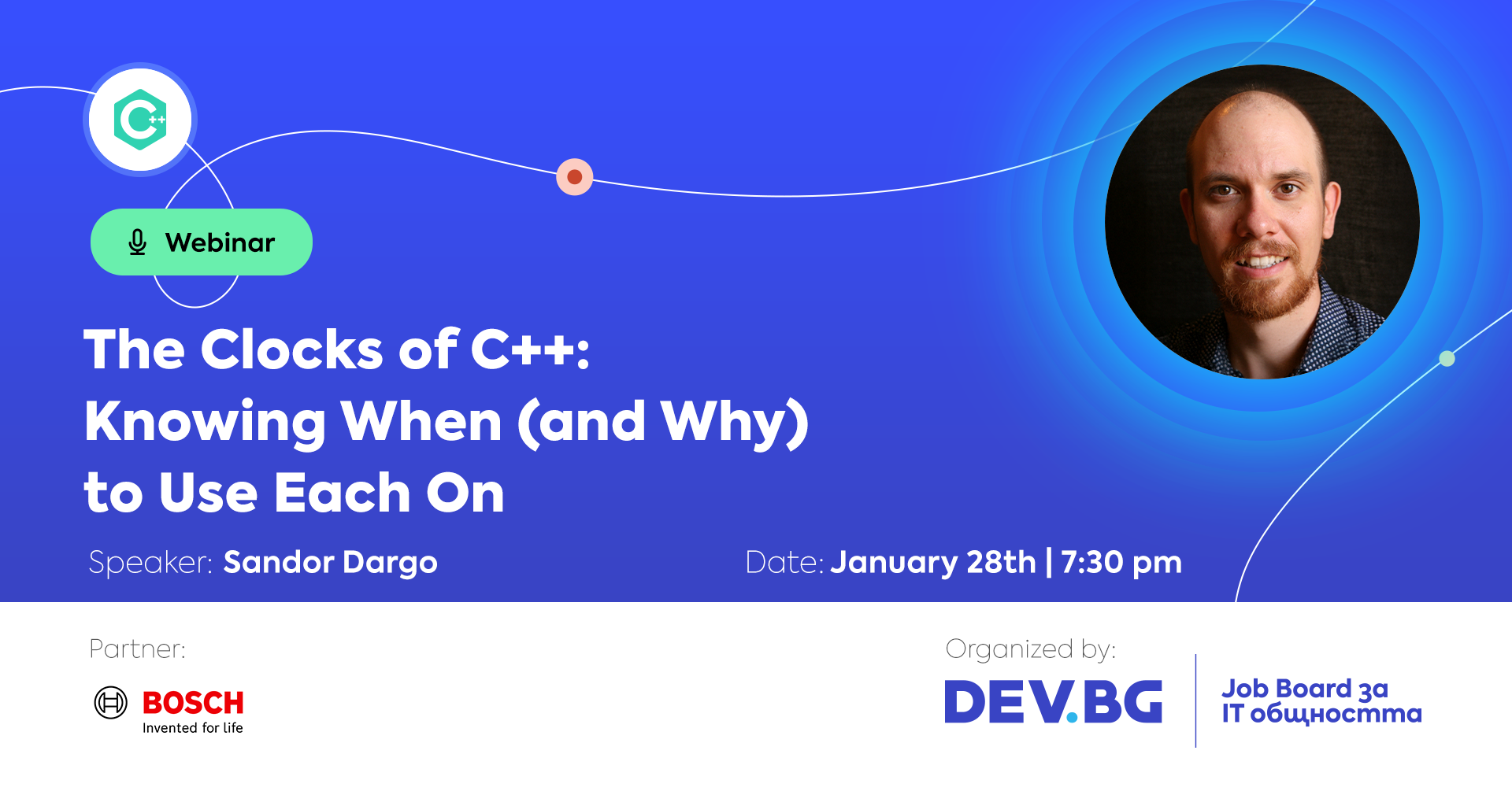
The Clocks of C++: Knowing When (and Why) to Use Each One
📅 Date: January 28, 2026, 7:30 pm
🎟️ Speaker: Sandor Dargo
About the speaker:
Sandor is a passionate software craftsman focusing on reducing maintenance costs by developing, applying and enforcing clean code standards. He also shares knowledge both orally and in writing, inside and outside his workplace. In his free time, he enjoys baking with his wife and two children or traveling to new places.
ℹ️ About the event:
The event will be in English.
SPONSORS:
Bosch
This event is part of the C/C++ user group.
Agenda:
- Introduction - Time in C++ is subtle. Misconceptions—like relying solely on system_clock—can cause bugs. Let’s learn about the different clocks.
- The Building Blocks of <chrono> - Understand durations, time points, and clocks, plus safe conversions and simple examples.
- Meet the Standard Clocks - system_clock reflects real time and may jump; steady_clock is monotonic; high_resolution_clock is often just an alias. Learn to pick correctly.
- The Latest Clocks from C++20 - A quick tour of utc_clock, tai_clock, file_clock, and modern timezone/calendar support.
- Testing and Custom Clocks - Why time breaks tests, how fake clocks help, and injecting clocks cleanly.
- Closing Thoughts - A brief recap and a practical clock-selection checklist.
- Q&A
The event is free, but pre-registration is required.
USER GROUP: This event is part of the C/C++ User Group. Every month we organize events on C/C++ related topics. Subscribe to not miss any updates.
Organized by: DEV.BG, a specialized job board for IT jobs.
C/C++ Job Offers: Looking for C/C++ related jobs? View listings here.

This event is free to attend
Free registration is required to attend this event
Register for Free