“No SPoFs! No Admin! Open source cryptography for making big brothers redundant.” – Syed Hosseini
About this talk
This talk discusses the importance of decentralization and cryptography in eliminating centralized points of failure in technology. The speaker, a researcher at Web3 Foundation, highlights the dangers of relying on major tech companies, often termed 'big brothers', citing examples like Apple, WhatsApp, and Google, which can compromise user privacy and data. He elaborates on various cryptographic primitives, including encryption, digital signatures, and zero-knowledge proofs, which can replace centralized systems and ensure privacy, authentication, and data integrity. Furthermore, he introduces decentralized applications like Delta Chat that leverage existing email protocols for messaging, decreasing reliance on single entities and enhancing resilience against censorship and failures. The session emphasizes a shift towards open-source and decentralized approaches to build more secure and efficient systems.
Full transcript
Hello. Are you still awake? >> Still not sleeping. Woohoo. [screaming] Yeah. Great. So we have one last speaker today on our stage and uh he is a mathematician. He almost got his PhD. I think he's almost got it or you got it already. No, he almost got it. Okay. [laughter] Uh he's from Web3 Foundation and uh he's going to talk about uh interesting things about cryptography. So
let's welcome on our stage SAD. Say it right. >> Yeah, say it. Yeah, thank you very much. Cool. Um, thank you for intro. Um, okay. So that is uh thank you for coming. Um, so this is uh the talk um we are going through today. Um, so I'm just going over um what I'm going if it works, which it doesn't. Sorry. Okay. Um so I I give
a quick introduction that what I do in my life and then uh give you some motivation some situations that's uh this uh big brother this single point of failures fails people and and and uh fails us and why so motivate you why we need to replace them and then um I talk about the cryptographic primitives that we can put and take these big brothers out and put
this this instead so we get a very system. Uh just a a quick um introduction that what we do at web three foundations. I'm a researcher there. We do we uh invent implement new cryptographic uh algorithm. Um the goal of V3 foundation is to um support um decentralized software and the product mostly we work on is polka dot is a multi-chain network and it goal is make
a decentralized systems uh much cheaper much faster much more efficient the way that we can com compete with the centralized world moving on the I'm talking about um the big brothers that we have in this world and um how they can they can they can make problem for for our for our um um applications. So talking about Apple, WhatsApp and Signals, Google, Windows, just for some example
that how how they become dangerous or um in the but there's many of them you know anytime you use something centralized you know you're opening your your yourself to the possible failure. Um so this one is very recent. So there was this um application called ICE block. So ISIS stand for um immigration and custom enforcement for us. And basically what was it people were were reporting um
agent um that um they they see so basically there's a central database you have the app on your phone you see an agent in your neighborhood you click you say I I'm near an agent and then uh it would go upload in I iCloud which is handled by Apple um and then so that that's um report and what will happen is that uh the Apple system basically
you can ask Apple say I want uh for this location anybody near five mile of this and has my app send them a push notification and so that that was the system how it worked and and they they had lots of lots of users I would assume in in millions and um basically was helping people just to you know to hide when they see a um ice
agent nearby. Now the problem here is that Apple completely control everything here, right? So um and actually the developer who for some reason didn't even open source the software um thought that's that that's the feature. Um so they in in part refused even to um publish an Android version based on this reason that they call it a privacy concern. So so what what is the point on
iOS you could tell Apple anybody near this location send them the push notification they would the the developer the app the app does not get any data from people who get the push. While in Android, Android would gives you the identification and then you send a push notification for them. And and the their idea was that if they get a varant from the judge then they have
to give this all the ids in Android that send them that they send the push notification to and then for example then you know ice will get that ids and then go and find them like where they are. In theory the idea here is that as the graph and OS people were saying is that this is this is not they the judge does not need to give
the the varant to the app developer they can just bring it to Apple and even before here Apple was giving information to law enforcement even without court so um the the the opinion of the developer that why shouldn't we do it for Android was completely um false and um so eventually what happened what happened with the big brothers this happened So Apple basically um the government of
US contacted Apple and told Apple to remove it and Apple removed because um they have other thing to do in their life. They don't want to deal with the government and and b the worst thing here is that on Android you can you can install app apps that are not in the in the app stores but here in in US because the custom uh custom protection is
less than Europe. In Europe, you can also install apps that are not in the app store. But in US, you only can install apps that are app store. So it's like a super big brother. Apple Apple doesn't want to put your app there and nobody else has any way to install it. They can decide not to send a notification. They can cut your access to the iCloud.
The whole system fall apart. You have millions of users and and after that nothing. You can't do nothing with your I mean you had a mission, you had a goal and everything fell apart. Um next example is signal and WhatsApp. Um this so at least signal is open source and it supports end to end encryption. So what happened in the story is that UK passed this online
safety safety act and you know that all around the western world there's defender for this act because mainly because the intelligence agency don't like encryption. So that this act basically says if I go to the provider they have to inspect the encrypted content which already is a weird thing. If it's encrypted, if it's end to end encrypted, I don't have the key, right? I don't have the
key to that counter. How can I inspect? Um, so basically they want them to to WhatsApp and signal to scan end to end encryption messages if they ask for it and obviously the reply is that I cannot is end to end encryption. Then they came up with this solution. So they ask them to hash they they're very very worried about the images for some reason. I don't
know. Uh anyway, so so they they hash the image. You send the image to your friend. The message is and and to en encrypt it. So your your your image is encrypted, but they ask them to hash the image in uh the hash the image, which is like a scrambling this image all in a one fingerprint and send it to the basically law enforcement. So anybody or
keep the hash basically he keeps the hash on the signal server and then you know when the law enforcement come and says send me the the hash of those images and the law enforcements also has all the hash of all the images that they are suspecting in their central database and then they come to signal and say send me the hash and then I'm going to compare
the hash and if they match then I know this user was talking about like I don't know like child poor content or terrorism or whatever they think. The problem is that you know if there's a protest and the protesters sharing the hash the government also can use it. Um so the hash is unencrypted and they say they send it there. [snorts] Um so they can compare the
hash. So um the result was okay signal said and WhatsApp both of them they said if US if UK government come to me and say do that then I'm going to seize operation in UK because uh you know that's that's the point of what they want but that is not the point then you know you you you are a single point of failure you wanted to give
end to encryption to people to provide it to that and then you know you the government says you cannot do it then then signal will go down and then what do what do people do they they move from to end to end encrypted platform to those that are not end to end encrypted and then they they lose their protection. Um this is not seems a working solution.
Um another example Google um uh so I did this basically I I took my Android I installed a free operating system on it. So I took off Android and installed Lineage OS and then stuff stopped working. So Google will let it stop working immediately. says, "Oh, you touched your um uh boot loader. Basically, you unlocked it to install another OS that I didn't want and so I'm
not going to work with you." That is completely outrage like you're providing with a with a credit card service. What is your business with my bootloader? But that's it. His big brother is control everything. They can overnight say okay, you cannot use your thing. Um worse than that was my bank account. I try to install my bank account. First of all, it gives me OTP specifically from
the bank. Um like they send their their their password provider and they say you have to install this and so okay I'm installing this and then um what happened is that their the OTP wanted to use some Google Play services completely. I don't know why is a OTP the OTP you are encrypting the time with your seat and you get a number every one minute basically and
you you really I don't know what is the relation between Google play service and this but then basically they blocked my bank account because I used a free operating system this one Richard Stalman um categorize Windows as a malware and he that is what he says so he says he has universal backd dooror basically Microsoft can install anything on your windows without even asking for a permission.
So an example of this which is bit controversial but I just wanted to talk about it. It was a botnet that was using tour. So is a malware that comes your computer install to and start attacking other website through tour. So what happened the tour network traffic went very high. Um so to tour network the the the tour people they were not very very very excited about
it because you know it increased the consumption of the network and then what happened is that one one day Microsoft eml tour and said what is the probability that the user put the to executable in into a slash windowsystem 32 and to replied to them that you know is not very probable and then the day after all the botnet disappeared. So what happened? Microsoft had pushed the
update that went on the system 32 and deleted that file which you might think that is a good thing because it was botnet and was harming people but um the idea is that Microsoft can come to into your computer and delete anything they want at any time they want. You know you have no control over it. Uh so um that's that that was example of um situation
that happens when when when a player has so much uh power as a central service be Microsoft or B Google or B signal even signal you know all the messages go through signal saver uh and then that point fails and then um you have no u uh action like a is failed and then you have no escape from it. So um we want to design a systems
that's you know they don't they don't have this type of big big um point that that that that control everything. Um to do that we want to see first why do we go to this um big brothers these big uh providers and and what what do we want from it? So we go for for various type of protection to these people that is why uh uh we
turn to these uh big services. So one of them is privacy which um we can eventually replace with encryption you know but we want our data to be private and then um um we use this uh big provider and just we try we we we trust them with the privacy. um we uh we um we we we go them for trust and integrity. We know we think
that you know if my data is on iCloud then nobody else will change it. I don't want to put it like open in the internet. Um or you know like the the the developer says okay ask Apple to send a push notification they are going to send it because I'm trusting them. um authentication. Yeah. So I you know uh you use them you know you you you
trust them because they they will go out authenticate the users. Um data and service availability you always um your data you you leave it with them because with a high probability you think your data will be there next time you want it or you go to you use Amazon AWS service you know that you know it's probably their service is up. So if your app is on
that and then it's probably working and then identification identification is more complicated but usually we go to government for identification of people you know like um if I want to ID somebody either I ask for their passport or like you know maybe phone number but the phone number is because you thought that they use their passport to get their phone number stuff like that. Um and the
idea is that can we just replace either of this protection that we're asking from these big providers uh with something u more um using cryptography and using distributed service can we replace all these and then as a result we do not need to have a big brother in our system that can fail for various reason and then our system will become more resilient. so privacy with encryption.
So part of the privacy that concern we have is encryption, right? So is is basically you don't want your data to be to be revealed and that that can come with encryption, right? So, so that that that's that's the easy easy solution solution like uh and that is why you know like end to end encryption should be like by default set set in every every app you're
using like even if you know Apple keeping your iCloud they has not they have nothing to do with to know what is inside that iCloud for example um so what is encryption is to apply you know a mathematical function that's we don't know the inverse for it like we as a human being we don't know how to to find the inverse for it and then uh it
will change your data to the way that you know everybody else sees it cannot cannot inverse it and uh so we have this from Snowden that this work right so he he he was from uh he was working for NSA and then when he came out he says basically a good encryption is one of the few thing you know NSA hasn't figured out how to how to
break so basically if if you have a good encryption then you can trust your privacy pretty well you put your data in open. You don't need to to trust Apple to keep it secret for you. You can use encryption to keep it secret. And here I want to to um branch to open source cryptography. So here what uh this is the basic principle of what cryptographer works
on. It's called Kishov principle and and it basically says your encryption should stay encrypted no matter if every everything about the system is known to anybody else. The only thing that shouldn't be known is the key. So when when you design a crypto system, you cannot hide any part of it, any code, anything any else. And basically that's mean if if you have a good cryptographic system,
it should be open source. If your system is not open source, you're violating this principle. And basically you cannot be trusted. Um an example of it is like this company Crypto AG which was a Swiss company and basically was selling ciphers to around the world and um eventually it was it was closed source at the time. I guess open source was not was not that that big
thing and and and people actually thought oh is a encryption system so nobody should know about it and basically they they they secretly got bought by NSA and and the German intelligent agency and got money from NSA to basically uh the crypto basically they were designing broken crypto systems and sold it like to Iran and and Libya and bas and then West completely had access to their
encrypted systems. Um so you cannot really um trust closed source crypto. Um so yeah so let let decide from now if somebody's closed source like a I don't know the encryption of the NTFS system that comes with Microsoft probably you cannot trust it at all. Um the interesting thing about crypto AG was that they would sell product that they look completely the same. They have the same
name but when they sell it to Iran they would like bug it and they sell it somebody else who was different. So you know when you don't have open source you don't have reliable compiling situation to see exactly I built a exactly the same thing that you built. So my product product is the same as as yours. Um the other example is the crypto was open but
the design was closed and and it resulted in this is called um dual elliptic curve deterministic random generator which is not random it's deterministic so it's a pseudo random nom generator but um they call it this way so early 2000 NSA went to ANC and said can you make this a standard this is a very good thing and you know they gave the design and they said
this is how we are going to people are going to generate random numbers like you give some seed to it and then you generate random numbers and using that random numbers and you're going to generate your keys. Um 2004 RSA makes this a um standard and publish it in their B safe. So be safe is a standard that US governments ask people all all companies that work
with the federal government they have to follow they they have to use tools that adhere to this standard be safe and they made um this uh dual EC random bit generator as a part of this and basically it was that um if you want to do you know in public key crypto uh you want to use key generate key you have to use that um in 2007
so that Bruce Schneider he published an article says did NSA actually put a back door there and the idea was here there was two prime number there P and Q and if this two prime number they had a relationship that nobody else knows yes so I'm I'm going back I'm I'm getting back to this but I love this crypto system works on the fact in a group
that division is hard right so Um so if you have these two point and then one of them is multiplication of the other one um then this system is broken but the only person who knows that this relation exists is the person who generate this relationship but um this design come from NSA and says use this we we have no way of proving that these two don't
have this relationship but if that relationship so the article was saying if that relationship exists then then the system is broken. And uh 2013 Snowden leaks NSA document 2013 basically Times says uh publish an article that says actually NSA um put a back door in exactly this because it was possible to do it. And uh actually again from the same leak document Reuters uh published that RSA
got $10 million from NSA to actually put this in B safe and implemented it. Um so that is an example that the the protocol could have been secure but because they they they played with PNQ uh the way that was it um they it the whole system broke right and and that is the bad thing about the the chain is like you generate the key the key
can be predicted and the whole thing after even they are secure because the key is not random is broken. Um the lesson here was um at least the process was public and in public eyes people looked at it and said this is this might be broken and they found out and there was a lot of warning and bell went off that you know don't use it. Now
suppose it was a closed source crypto you would know nothing about it and they can do whatever they want. Um so that was about encryption for authentication. uh we can use digital signatures which again you know you don't need any any any server or something to verify it you can um if you have the public key of the person then they can use digital signature to authenticate
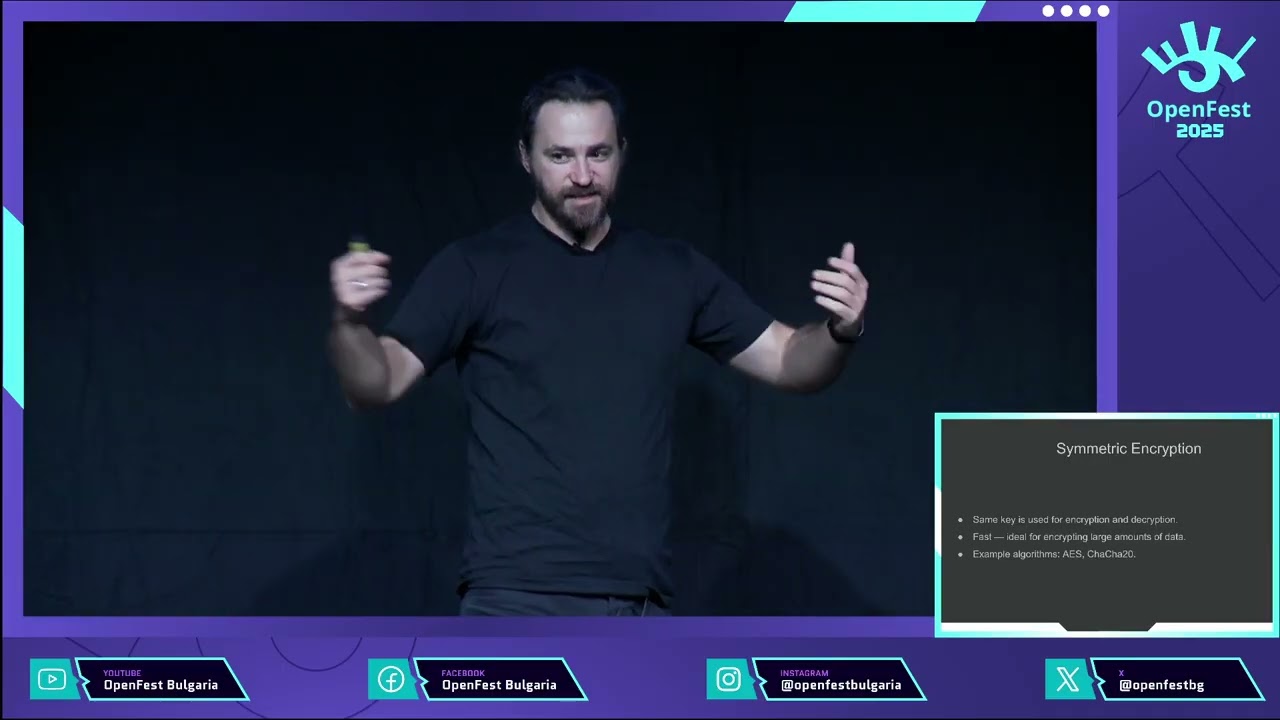
that to you um uh I'm I'm going a little bit the mathematic of this because um I'm going to use it later but that is the most of the math that you will see in this talk but I'm not going to more deep into that but um just um going fast on the digital signature just you hear this this war secret key public key. We'll see how
does it work. Um so you choose a secret key which is a suppose it's an integer. Yes. Yes. You choose a integer is secret. You don't tell anybody about it. And then there is this uh mathematical structure that um these are objects that you can multiply integer into them and that is very easy but if you want to divide them by that integer is very hard. Um
so then basically what you do you you take one of these object you multiply everybody knows that the G right you multiply your key with this which is basically you add this G S time together and you get a new value which is P but the the magic behind this is that I give you P you do not and you know G and you know P but
you don't know how many time I added G to get P or you don't know basically how what is the value that multiplied in P that you got P and and that that is uh the base of this um the security of this crypto system is based on so um this is the most mathematical slide that you will see and then after that um I I just
refer to it few times. So, I want to sign a message, right? So, this is this is uh this is digital signature. Um this is my message, you know, I want to prove that I give $1 million to somebody. Um I generate a random number K. Okay? And I don't tell it to anybody. I multiply this K with the same G that that object that I could
multiply with easily, but nobody knows what I multiply with. So, if I reveal R, then nobody will know what was K, right? because that's that that the property. Then um I put this new R that I found attach it to a message that I want to approve by signing and I will hash it. So when I hash it is basically I scramble it and I get some
fingerprint from it. So this this function just take these two together scramble and it's very hard to for you to know what what was the scramble that got that and I get this E which is which is the integer again and then I write this this this relationship. So I get the key that I didn't I generated. Now I multiply and I and I um subtract um
E the scramble value uh times S my my my secret key and then um whatever comes out of it I send it to the world as my signature. That's so I send give $1 million to XY Z plus this is my signature and everybody should be able to verify that. So um how to verify it? You just need to note that um K the secret value that
I have is equal to this public value X my signature has this two integer in it plus E * S which is my secret key. So if I have this I cannot people cannot cannot verify this yes because they don't have S and they don't have S they don't have K they don't know. But if I multiply basically both side by dg this object that was easy
to multiply but hard to divide then I will get to this this equation. And now k * u was r okay x * g I can do it because x was in the signature. I'm I'm the person who verifying the signature. I can multiply x by g. And um I cannot multiply s by g but I already know your public key. I know this public value from
you. So I can just replace that with p. And e is public. So I can multiply it as a result. I have the um I have the left uh of this right. I can compute this. As a result I can compute R. I know what you sign give one me together and and I will put it in the scramble function and I see if I exactly got
the same e or not. So this is uh how how how digital signature work. But why did I bring it up? I wanted to talk about another concept. It's a zero knowledge proof which I come back to it when I want to replace some of this power that people have with uh with something that doesn't rely on the big brother to do and that's zero knowledge proof.
Here this is example of zero knowledge proof. So in this process I proved to you that I know S right? I know S the secret key without revealing anything about S. So I'm telling you I know a value that if I multiply with G it gives me P. I didn't tell you what it is but at the end of the process you are convinced that I knew
s otherwise I couldn't do this game. So this is an example of zero knowledge proof. So I I I prove something to you without revealing any extra information. I didn't want you know anything about my secret key but I prove to you that I know the secret key. Um so this all bring me to open PGP and GPG. So uh open PGP is a standard of all
this um encryption algorithm and digital signature is a pretty uh known standard and GPG is open source implementation of that um is a GNU privacy guard and is heavily audited that is very important in cryptography you make a mistake then your whole system will go down or like NSA put something into it and the whole system will go down but this is heavily audited so it's very
good if you can use them in our projects you know and and is open source and free software. So is there um and this will give us encryption and digital signature which can we can use for authentication and others. Uh the other missing piece uh that we don't have here uh is decentralization. So we got encryption, we got um authentication but we still don't have this which
is availability. you know, um, I have this server and I go to Amazon AWS because most of the time, at least 99% of the time is is there, you know, as long as they're not pissed off at me and and kick me out of their system, then I think it's always there and then I my customers won't be sad about it. While um, if I have a
random server that maybe goes down, maybe my ISP doesn't work, maybe this and that. Uh, to um, mitigate that, you basically decentralize. you have many servers that are going to do that. These uh people here I think for example you know you copy your hard drive few times so if one of them fail you can have more of it. Um more than that uh decentralization will help
you to uh put check and balance on the power right so this is how it works you say okay don't trust one person distribute the key between four people so they you know at least three of them can can get together and make a decision. Uh so here you know we are talking about free software and open source FSF you know the second high priority of FSF
is decentralization. So what what is concerning is that you know we should be able to self-host decentralize and that's that's basically one of the one of the uh critical part of having a free software because the moment you don't have this you you have a you don't have a free service Apple will close iCloud and you know you have nothing else to do. So I wanted to
bring an example here um that's called Delta Chat. You probably haven't heard of it. Okay. And I want to compare it to signal. So um people in Delta Chat um they came and say look there's already a distributed resilient network. It's called email. While like you know a lot of people always use Gmail for their email. It when they invented the internet that was not how it
was worked. it um they said every university have their own email server and this and that and then this email server should be able to talk to each other. So there are already a lot of email server and and the network the email protocol is designed to have many many email servers. So why not using that and is is a messaging tool you know they can talk
to each other. So that's the thing and then we have a reliable encryption and authentication protocols implemented in GPGs which are already there we can use it and then they put this together and then they made a messaging app that actually does not need a server you know like signal if UK government come to Delta chat and say you have to do this they they don't exist
basically there's just an app which actually you can install on Android without the app store so if and if they come to app store and say take it down you can go and install from market. So, um none of those stuff that signal might might fail in Delta Chat will fail. On the server side, you you need to install a um email server basically, which takes you
maybe half an hour. All you need is to have a D domain. You set up the domain. You say this is a email server. You put you know your credential in in the DNS and then you you run the script and pull pull out a new server. So I did that in half an hour. You you see this is the delta.codequisine.ca is is is a server that
I put there. And if you want you can get an email address here. And who am I? How can you trust me? The point is you don't need to trust me because I can't read any of your messages because they all come with GPG one. And what if I shut down my server tomorrow and then you cannot talk to your friend anymore? It's not like that because
you can use any email address that you you control to uh to chat with your friend. All you need is your private key which is on your cell phone. I go down, you change your email address. The moment you send the text to your friends, you make a key exchange and they know you are the same person. So the authentication come from the secret key on your
cell phone. You're not trust you're not relying on me to not read your messages because they cannot. there encrypted and you don't trust uh on me to authenticate you to say oh you this is the same owner of the email to check your password that you're the same owner you don't you're using open cryptography you are using your secret key to authenticate yourself to your friend you
say I'm the same person who had the secret key yesterday even that my email right now is a totally different server so um that is you see how much much more resilient this than than um signal The other thing for example an example if you go to Doha airport signal doesn't work because they don't lock signal. Um here if they're going to to to to um censor
emails then basically they are going to stop all emails in the world. I'm using something that is already used with a lot of people. If they are going to drop all emails in the world then just to stop people from talking on Delta chat then then that's that's a very high price to pay. So even that it has a censorship resistance. So it's much more resilient than
something like signal and much more something than you know I don't know like AOL messenger something that wasn't end to encryption. Um the other way to give um uh availability resilient to your storage to your data availability uh is to use DHT. So there are solution already there you know they use DHT to find your material IP IPFS B to that is how B to works I
can give the the address of my data on the DHT so there's no if somebody in the network knows it then they give it to you it's very hard to to take that kind of network down um or using other you know redundancy solution or tools which has end to end encryption inside it um the Other thing that we we we need um to replace sometimes is
consensus. So um that that is basically the part that blockchain will give you. Um you choose either a random leader to decide what is the truth uh what to to to run an operation that is like proof of work like bitcoin or you can use a VRF verifiable random function which I I'll go back to as basically you you roll a dice and say the person who
got the dice can do the operation because it's distributed. So basically what has happened that or you can use bizantine fall tolerance so people votes on the fact I'll get back to the bizantine fall tolerance uh protocol but for now I I I want to talk about VRF which has much more u uh more other uh application beside um you know choosing a leader. Um so VRFs
are um very follow random function. They are basically you have a secret key you have a um seed you you generated a random value using uh your your um uh your uh key key and the seed um people can verify that you have not cheated. So the the good the good thing about this you can roll the dice once but you cannot roll it again if you
didn't like the number. So you are doing a you know uh deterministic random generation and uh people can verify that you haven't lied but this is basically like using digital signature that I showed you. So I'm going back to that. So when I'm signing when I sign a gener the signature that come out is random but is deterministic. I cannot sign and get in in in this
signature that are used for VRF. Every time I sign, I get the same signature is a random number that they generated by me. Um, so the other piece of of of of computation that you want to uh um replace is private computation on private data. So when you go to your bank and and you transfer money, the bank completely see everything between the beginning account, the next
account and everything. But you trust them because they're only one entity and they promise not to tell anybody till they tell the government or somebody else. Um here you need to do something because you don't trust anybody. We are decrease the trust. We don't want to trust. So we want we we need to replace this private computation and data with something else and that come with zero
knowledge proof which I showed you a very very simple example of it there. Um or you can use a homorphic encryption. So that's doing operation on the encrypted data without knowing A or B. I can add them together. These are much more preeitive than zero knowledge proof. Zero knowledge proof can basically do any operation. This operation that I told you I take your money from from your
bank account to my bank account without knowing who are you and who is me and how much money was in your bank account. How much will be in my bank account. You just you just verify that the operation was done based on the rules of the game. Um the last thing I want to talk about is proof of personhood. Um this doesn't have a real cryptographic solution.
So currently we rely on uh government passport to to verify people but you you can um do like crowdsource version of this. So at web 3 we are working on this. So if if like you know 10 people every week they say you are the same person then that that way it gives you a person who then you're not a AI bot or something but after you're
you're a person who is established in the system then you can use ring VRF and other thing that is based on ZK to um do operation for example you want to give universal income to every single person they generate a seed using the VRF and then they they run a ZK proof that they the seed was corrected it correctly set and you are you are a person
you generate these two ZK proof you give it they send the money to your your seed account if without knowing who you are and uh the only thing they trust you are a human being because you you run the ZK proof um finally there's sometimes there is that you cannot um replace this trusted authority you can crowdsource it with kind of crowdsource distributed key distribution um in
uh cryptog graphy that when twothird of people they say yes then that authority will be yes but at least it's better because it's crowd sources rather than having single authority decide about everything um this is the detail of how how to do crowdsource but I'm I'm okay um I just say fast thing so so the the thing is basically is based on VRF uh but um it
resolve the situation when you know somebody want to cheat by not not revealing their VRF so um in conclusion uh we can use all these cryptographic uh primitives and and and distribution technique basically to eliminate uh single for point of failures and um we can um basically get a much much more resilient system that's you know some random person one day wake up and turn the switch
off cannot turn off our systems and then I we will have our customers u it's just that much less convenient than central system the the code is more complicated the cryptography is more complicated but in long term I think uh you know this will reward uh you with more resilience so maybe we should get out of our com comfort zone and um you know start developing systems
that are more uh open and more uh distributed. Thank you very much. >> Thank you very much. Are there any questions? Hello. But I I would like to ask you what will happen if the bat state players can mask as users and they infiltrating this system. It mean that they can uh get data data for the user or for anyone that use this service or that want
to use this service anonymously. So what stopped them to to mask like regular user, regular players? Thank you. >> You're welcome. Um so the general approach is um I'm not going to trust you are not trusting me and I'm not trusting you. So for example in Delta chat as I showed you I have a server here you're welcome to join but you are not trusting me. So
that the other users they should know that this uh bad actor in the system should not uh they should not trust. So to to begin with they will not put anything unencrypted on that system. No matter you know how reputable I am. You should not trust on me. You put your trust in mathematics and cryptography. So for example if I'm a bad actor and I really actually
want to see who is sending like what message people are sending and because of that I ran a delta chat center server and brought it here. You look at the system and you see okay my message is encrypted. No matter what say is is a bad actor or good actor. You cannot do anything about it. Um the exception is here that I said you know when we
have this then uh we for example you want to do crowdsource encryption you want to encrypt something that's you know you want the authority to decrypt it in future but there I say only when twothird of the actors are agreeing they can decrypt this message so as long as twothird of the bad the the actors are not bad states then then this system will will stay resilient
much more than you know one estate can decrypted which can become bad you know I don't know like the one that went to Apple and said bring down you know the app the app so the on the central system one one bad actor can bring the whole system down here at you at least has have have the guarantee that if twothird of the people are not bad
it will stay resilient >> thank you uh we don't have any more time so thanks again round of applause Please. Yep.