
About this talk
In this keynote, Dr. Plman Rusev discusses the profound impact of artificial intelligence on society, framing it as not just a technological shift but an economic revolution. He explores the emergence of three distinct categories of humans based on their cognitive relationship with machines: those who command AI, those who follow it, and those who are left behind. Rusev emphasizes that the future economy will be dominated by 'AI native' nations that can effectively harness these technologies for competitive advantage. He warns of the dangers of surrendering proprietary data to AI systems and argues for a shift in how we perceive both jobs and value in the age of automation. He posits that those who can command machines will thrive, while others risk becoming economically irrelevant. The session culminates in a call for individuals to protect their agency and invest in relationships of trust as the core of future success.
Full transcript
Up next, please welcome Dr. Plman Rusev, founder of Webbit, with the keynote, the next decade will be built by AI native nations. Dr. Plman Rusev will open the strategic conversation of Webbit [music] Sophia 2026 with one of the defining questions of our time. Who will lead the AI decade? This keynote will frame [music] AI not only as a technology shift, but as an economic revolution, a sovereignty
race, and a defining [music] moment for global competitiveness. As AI reshapes industries, infrastructure, talent, capital, and geopolitical influence, the next global leaders may not be the biggest, but the fastest, most adaptive, most execution focused, and most AI native. to explore who will build the next economic system and who will be left consuming it. Please welcome to the stage Dr. Plman Rusev. >> Good morning. Good morning everybody.
Welcome to Sophia. Come on. Come on. Come on. Come on. Come on. I want you I want you a little bit more awake. Awake. Thank you so much. It's so amazing to be again. Oh, did you wake up also? Okay, let's do something. Come here. Come along. Come along. Come on. Okay, wake. Uh, get up. Get up. Get up. Come. Come. Come. Come. Come here. Get up
everyone. Come on. Come on. Let's do some morning exercise. Let's move. Are you ready? Start. One, two, three. You start first. Come on. Which one you choose? Which one? Which one? Choose. Choose. Choose one. Exercise. Whichever you you start. Okay. Go. Which one? Okay. This one. Come on. Let's Everybody do that. Come on. The robots will show us the way. Come on. Wake up. Wake up. Wake
up. Come Come on. Come on. Come on. Oh, this one. This is the moonstep. All right. You wanted robots. There they are. They're teaching us how to wake up. Come on. RAISE UP THE ENERGY. BRAVO. Thank you. Thank you everyone. Well, that's a good start. Go to sleep now. Go. You too. Come on. Go. Get left. Left. Left. Get left. Come on. >> You should help this
guy. I think he got tired. Help him sit. Help him sit. You go down the ground, please. Down. Come on. Come on. My dog listens more than than you. Come on. Go to the ground. THEY FINALLY do the right things. Ladies and gentlemen, dear friends, wonderful people from all around the world and particularly fellow Bulgarians. You know that everything we do here, we do it for one
sake, not to show you the f the future, but actually to bring the future to where we are. And uh saying that almost an year ago um I have put a piece of information which I called the trust capital and uh I wasn't trying to predict the gadgets that you see all around and you will be seeing more and more often and often. I was trying to
answer one question. In a world where machines get better in almost everything, what holds its value and what loses it? I made my predictions 10 years ago and almost all of them turn to becoming true. But there was one more I never published. I crossed it out not because I was afraid but because I didn't want it to happen this morning. Unfortunately or fortunately I will share
it and I will give it to you. the three kinds of people. The world is splitting the same way it used to be 40,000 years ago. Back then we had homo sapiens, the Denisosus and we had the uh third part which was um something that we are using now to say bad words about people but actually they were quite big and quite strong kind of humans back
then. Those three were completely biologically different. Now in the next 10 years we will see three different type of humans based on their cognitive difference and now we are talking about business how this is going to happen and how this is going to drive economies. I split them into three in the book. I call them homos delegatus homocyntheicus and homos proctos. But if you have to split
them in more of easily understandable groups, I call them those who command the machines, those who get commanded by the machines, and those left behind. And there is only one way to know which side you're on, whether you command the machine or obey it. Now um two probabilities. Let me make that concrete because it's sit it's sitting in the room right now around us. What I I'm
sure is the probability that someone connected to this room will build a billion dollar company in the next 10 years is higher than any point in history of humankind. And the probability that someone is going to become economically irrelevant is also the highest ever. The two people are often sitting next to each other. They don't know which is which. It's still being chosen today. AI won't take
your jobs. Someone who knows how to use AI will do so. And let me start with the most concrete fear in this room. Your job. The World Economic Forum puts the numbers. 92 million jobs will disappear by 2030, 170 million more job opportunities will arise by 2030. There is a positive 92 million jobs. So, the work is not disappearing. It's moving. The only question is whether it
moves towards you or past you. By 2030, there won't be a shortage of jobs. There will be shortage of people who command and the army of agents. That's the new literacy. The reading was a 100 year Don't compete with the machines. you lose. Command it. And it's not only software. Soon robots won't be a demonstration on the stage. There will be colleagues in warehouses, in factories, in
hospitals and homes. Whoever learns to command them will be worth as much as 10 can't be. And most of you won't be the founders of a billion dollar companies. To you, I owe the truth that saves your job and your lives and your meaning of life. You don't have to be the founder. You have to be the one the machines can't replace. The one who decides not
the one who decided for not tasks. Now uh the fear you all carry but few say loud that the machines will take the power. Yes, they will. But let me be precise. The machines will never ask for your power. The machines One accept at a time. Every time you click the button accept without reading, no, the machines won't take the power from you. You will be delegating
it by default. You will hand it over. It won't be taken from you. You will delegate it. Remember this. You are doing it every day now. So here is the rule for the next five years. Automate the tasks. Delegate even the decisions but never the will. Not tasks will. You keep it for yourselves. And here I have to stop and to be honest myself in front of
me first and in front of you because you probably think I'm standing on the safe side of the warning, but I'm not. And right now I work with over 100 AI I've become many times more productive than I've ever been in my life in investments, in entrepreneurship, in the companies I'm running, the companies I'm on the boards, the companies I'm supporting growing on four different continents. And
as a fact, it's not an advancement. It's it's a phenomenal feeling to become super super productive. But the truth is that right now I'm more of a slave of a compute algorithms rather than I'm the commander of my own I committed myself to the promise of super productiveness because that matters for me. As of now, my most valuable resource time depends less and less on my decisions.
So, I do what I preach. I'm teaching the agents to manage agents to bring the hundred down to 10 and hopefully then only to one. So I will work with that one and I'll have my time back and then my agents will be managing this 120 more agents. So I have my time back but still keep the super productivity that I have as of today because what
really matters for me is my family, my time, my heart and my commitment to humanity. something there has changed. I have been meeting people in the rooms where trillions of dollars are decided. In the past, they were asking me about software because they know we are running founders games. Over 5,000 companies supply. Every year we give $6 million award in Davos. They are asking me about software.
Now they are asking electricity. The next great race isn't for oil. It's for electrons. Most megawws. The winner of the age of intelligence won't be the one with the best algorithm. It will be the one with the most megawatts. In five years, nations will report their AI capacity to the new way they report their military capacity. Today, we will be computing about energy and sovereign model which
are by the countries their own. And sovereignity isn't only your own model. It's a security. Whoever doesn't control their AI controls neither their data nor their defense. So who will lead this decade? Not the biggest nations. Not anymore. What really matters is that the leaders who will be the most AI native. The next decade will be built by the AI native nations and that is the chance
for small to overtake the big ones. Guard your data and electricity has a twin. Appropriatory data is what actually powers these systems. The models can be rented. The compute can be rented. You can you can use whatever you want to compute. But what's truly yours and truly scarce is the data which you hold. And this is where I see the most reckless behavior in the market today.
Brilliant people, serious companies, even governments pouring their raw proprietary data into systems that they do not own, handing over the one asset that cannot be bought back. We are entering the age of surveillance where the default is that everything you do becomes someone's else training data. Societies will be reshaped by those who watch who what and where is doing. So let me give you a rule I
follow without exception. I work with over a hundred agents but I build AI systems and I never leave them my raw proprietary data. I build layers of different systems but I only provide row data to infrastructure which I own and nobody else. The rest they receive business intelligence. So I have buil built three different companies during the past few months and one of them does exactly this.
It helps old industries leap into the future instead of going extinct without surrendering the data that makes them valuable in the first place because protecting your data is no longer an IT decision. It's a sovereignity decision for a person, for a company, for a nation. Guard your electricity and guard your data. They are the two things that will decide who leads and who is led. Now let's
talk about money. The money is a frozen promise of trust. It doesn't matter if it's paper, electronic or whatever. As a matter of fact, I think money will basically disappear. Not as a value. Money will will not disappear as a value money as an object, paper, coin, even the traditional bank account will become less and less central because money has never been paper. Trust frozen into form
we can exchange. So prepare your own trust. when we started you know many people say that's very easy how you prepare the trust that's why I've written the book the trust capital but let's talk about real stuff I'm an investor I'm not trying to predict the future anymore I'm buying it that's it I'm buying the future and I want you all of you to start buying your
own future because the other way around is to pay your rent to use it with web investor ment network. Three years ago, we've invested in companies that were making 60 million revenue. Three years later, they do 200 million revenue. And those are all companies that create the future. Because the next inequality won't be between rich and poor. It will be between those who own the future and
those who only rent it. We will go for the question which we already saw here. What if the machines answer everything in seconds faster cheaper and any of us what do we need to do as humans to be there and to have a meaning? I answer with one thing I'm truly afraid of. I'm not afraid of machine that thinks like a human. I'm afraid of a human
who stopped thinking because of the machine. The machine generates a million answers in a second and not a single reason. It knows how but we the humans know why. Intelligence is becoming cheap. Judgment is becoming priceless. So stop selling answers. Start selling judgment. And never delegate meaning. So far I've talked about trillions, but let's talk about people. Let's talk about us. Let's talk about children. Let's talk
about the next gener generations. Let's talk about the diploma versus the child. How many parents do we have here in the room? Please raise your hands. The hardest, the toughest job on the planet, being a parent, especially in the time we're living in right now. So the question is, what do we invest in? Do we invest in our children's diplomas or we invest in our children? I
won't give you theory. I will give you a real decision I've already made. We've already made with Angela as father and mother. We have a contract with our eldest son. He's 17 now. His mother and I set aside money for both of our sons education as we owed it most probably in this room but not for any university. We pulled the data which universities produced the founders
and teams that raised the most capital in the last 10 years. We made a list a total of 25 universities on the planet earth. our son came so said, "Hey, couldn't you find a university in a warmer place?" [laughter] Well, unfortunately, I guess not. Um, the deal is the following. Written on a Get into one of them, we pay. getting any other you find yourself to fund
your education or plan B you build a company instead we will finance the first with your when it fails we will finance the second one by then you will learn what no university can teach and you will have and you have built an environment around which is the real thing university gives because I'm not investing in your son I'm investing in you and that's the question every
parent here has already asked what am I investing in my child's diploma or my For the first time in history, your child's diploma and your child are two completely separate different things. Geography and talent. Somewhere here or in front of a screen there is 20 year old asking where to stay, whether to stay or live. I've spent 20 years between Sophia, London, Zurich, and tens of places
around the world. I'll tell you something I've never said. For 20 years, even more, the world has been over 10,000 kilometers away from us. it's a one click away. So for the first time in history, geography is losing value faster than talent. The world now comes to us faster than we go to it. And if I were 20 year old right now for I would choose to
build it right here. Really? And you should tell your children this because I'm a true believer that billionaires will be coming from countries like Bulgaria. Hopefully Bulgaria itself. Yes, I'm about to finish. If you leave with only four lines this morning, let them be this. Information becomes free. Computing power gets cheaper. Intelligence becomes commodity. Trust becomes more valuable. Everything that we can be copied will be copied
and will lose its value. only thing that will remain is the one that I call trust. The trust between humans. this is my message to you. Command the machines, own trust, sell judgment, protect your will, and never delegate meaning. Because the next decade will not be built on artificial intelligence. It will be built by the people, the companies, and the nations who learn how to command it.
Thank you so much dear friends. Now uh because my team brought this one here I want to give it away. Uh may I ask you for the microphone and if there's someone who wants to ask me a question a real tough challenging question. Please raise a hand and this comes to you. Who wants to ask a question? Oh you know everything. Come on. Did All right. There
it is. I thought I woke you up in the morning. That's why I I started with the >> Hello. Good morning. >> Simple question. What is consciousness? >> Oh, [laughter] all right. Stop webbit. It will be tomorrow. Uh there is a very good friend of mine whose name is uh professor Ellen Ledger and uh 50 years ago she identified and defined she coined the term mindfulness. Let
me do the easiest part of it. Ellen Ledger a professor in Harvard University she created the term mindfulness. She's the one who plays all the weird games with the people. So, one of these tests, I'm not sure if I mentioned to you earlier, is the fact that she brought a group of uh of uh insulin dependent uh people and um and all of them uh uh status
2 and put them in three different groups but hacked their watches. So, what happened is she made them play computer games. Every 15 minute the watch pings rings and they have to change the computer game. Three groups, three different rooms. Uh all of them had food of course before the test and then they got into into the testing room. First group their watches were not hacked. They
were measuring time as we measure it. Second one, their watches were hacked. They were measuring time one and a half times slower. Third group their watches were hacked. It they were measuring time two times slower. The result after four hours those who needed insulin and their watches were not hacked they needed it exactly on time two to four hours later after food. The diabetic talking about groups
of diabetic second second type. Um the second group whose watches were hacked one hour and a half one time and a half slower to to measure time. They needed insulin one and a half times slower. The third group that measured time two times slower, they need it two times later than the first group. Think about it. How powerful are our thoughts? Ellen Ladar says only 95% of
the people are mindful on the planet earth. The the lady who created who coined the term mindfulness says 95 are not mindful. you can say conscious the rest 5% hopefully will be creating the future and I hope a lot of these room people in this room are in this particular group so it's a long answer to your question but you won uh the trophy thank you hope
you enjoy it ladies and gentlemen it was absolute pleasure and is absolute pleasure to have you all here with us a full day of experiences, a full day of great and amazing insights is ahead of us. So I will let our AI assistant to lead the show further. Thank you one more
More from this event
See all 21 talks →
Webit 2026:The AI revolution is over. The AI economy has begun. I've seen the data. You're not ready
12:37
Webit 2026: Welcome intro - Aniela Russeva - CEO, Webit
6:31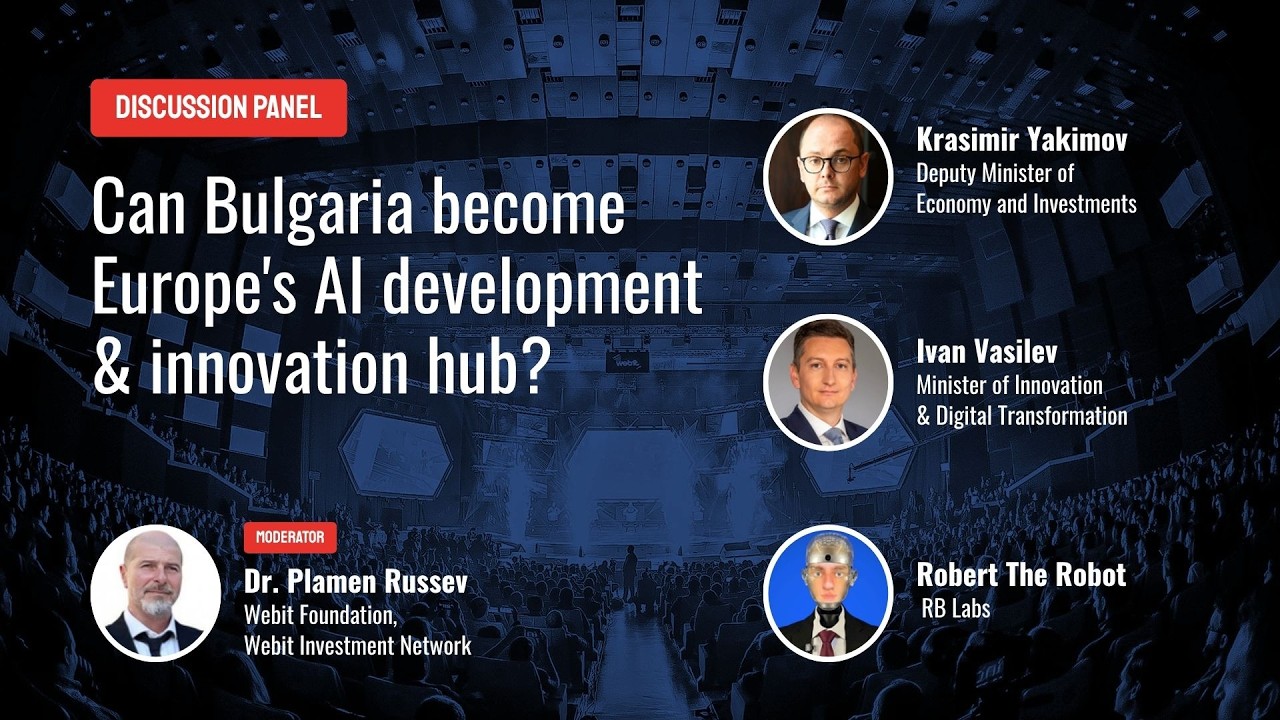
Webit 2026: Can Bulgaria become Europe's AI development & innovation hub?
52:35
Webit 2026: Designing a programmable future for commerce & payments - Petya Rusinova
14:25