About this talk
This talk serves as the opening address for the Open Community Experience (OCX) event, highlighting the importance of community in the Eclipse Foundation. The speaker discusses various exciting projects within the Eclipse ecosystem, including Eclipse Azimuth Sailing Analytics, Core-ET open hardware for AI processors, and the Eclipse Software Defined Vehicle (SDV) landscape project. Significant collaboration among open-source foundations regarding the Cyber Resilience Act is also emphasized, specifically through the Open Regulatory Compliance working group. A notable feature is the introduction of the Eclipse Foundation's Open VSX managed registry, which has evolved into critical infrastructure for AI development. This session concludes with a preview of upcoming talks and networking events during the week.
Full transcript
[music] >> Good morning, Brussels. How's everybody this morning? All right. Uh so, I'm going to immediately go completely off script and do a little audience participation game I always like. Cuz uh for those who've been around for a long time, I think this is uh of course before we had OCX, we had EclipseCon. I think depending on how you want to count, we've done somewhere between 22
and 30 various events of this size and caliber. Uh and so, um I want to start off by asking everybody who's been to Let's say let's let's start at 10. 10 EclipseCons or OCXs or more, stand up. All right, there's our old guys. All right, stay standing. All right, if you've been to six or All right, if you've been to five, stand Four. Three. Two. All right,
sit down. All right, so stand up if this is your first OCX. >> [applause] >> So, welcome to the Open Community Experience, and I really hope that this week will be a fantastic experience for you. The Eclipse Community prides itself on being an open and welcoming community. Um this is a chance for uh you new people in particular to spend a week learning um and making new
friends and new relations in the tech industry that uh can in in the case of many of us who've been here for 10 or more have basically lasted a lifetime. Uh well, this is my favorite week of the year. Of course, I end up being exhausted by the end of the week, but it uh the opportunity for us to all reconnect and rebuild those human relationships that
make the uh the rest of the year when we're working from our dining rooms and bedrooms and sometimes offices, um make it all go by so quickly until we meet again. So, thank you. So, and with that, let's get to the regularly scheduled show. Um so, this is the state of the union talk. I'm going to do a a few uh welcoming comments, of course, and then
talk about a few of the projects that I think are particular in technology areas that I think are particularly exciting, and then kind of draw your attention to some of the things that we think are going to be particularly fun and interesting um at OCX this this uh this And well, first of all, I mean, this is Brussels. This is the home of the Eclipse Foundation, but
this is a global community, and I'm really pleased to say welcome to people from over 40 countries from around the world. Uh that's really impressive. So, thank you. Um I know we've got uh well, we've got a speaker here from Shanghai. We've got people from all over the place, and it's I think that's just fantastic. Uh so, thank you so much for uh for those who traveled
from from far away. Um but really this this whole week is a celebration of our projects and the people that make our projects real. Um and so, I like to really uh call out the you know, over 400 projects, but call out a few couple of new ones that I think are particularly interesting. Uh the first one we actually have a talk on tomorrow. Uh Axel Uhl
will be talking about um Eclipse Azimuth Sailing Analytics. The cool thing about that is it's it's built on top of uh you know, a lot of the traditional uh Eclipse technologies. Think OSGi, think RCP, think modeling tools, and so on. Uh but it has actually helped run the sailing event at two Olympics. Uh and I think that's that's really cool to see uh to see our technologies
being used in those kinds of ways. Another one that's really interesting in open hardware, we have core ET which is a whole new processor family that's been contributed to the open hardware foundation helping extend the risk five ISA ecosystem into in this particular case AI processors. So building a whole family of AI processors in open source I think is really cool. And then Eclipse STV landscape the
STV area is one of the probably the fastest growing area software defined vehicle at the Eclipse Foundation and just it's gotten so complicated we need a landscape project to help explain it so you can you can sort of picture how all of these things fit together. So there's just a couple of new and interesting projects at the Eclipse Foundation that have joined the family of other 400
projects at at Eclipse. Now of course we would not be here with the help of many. And so I really want to thank all of the people who worked so hard on the program committees and Angelica who's the program chair stand up and give a wave Angelica please. >> Thank you. Melanie Bats who helped chair the tools thing at tools track Andreas Rexinger who worked has been
a fixture in our automotive community for years. Thank you so much. Lena Booker who worked on the open community for compliance and Sebastian Schill who helped with the open community for research. So these all of these separate program chairs have helped build the events that we are co-locating here at open community experience and with them with their program committees they put in a lot of thankless hours
so that we are getting a week filled with interesting and educational talks by great speakers. And again, so again, thank you everybody who volunteered on the program committees. >> And of course then there's the team that actually produces the show. So, Orly's probably way in the back, but hi Orly. Orly and her team have done amazing work to bring us here. She's particularly proud of this venue
because Brussels is her hometown and she loves to be able to produce a world-class event in Brussels. But the whole team has put in, you know, untold hours. Oh, there she is. Hey Orly. >> [laughter] >> Untold hours to make this all possible. >> So, thank you. Um and of course we wouldn't be here without our sponsors. So, platinum sponsors Huawei and Open VSX and the gold
sponsors SAP, Reply, LG Electronics and Red Hat. Thank you so much. Thank you all of the sponsors for making this event possible. You know, this putting on an event like this does not happen without the support of our sponsorship community and it's really been great to to see 29 sponsors in support of of OCX this year, which is fantastic. Thank you so much. Um and of course
thank you to our members. Now, I think if we put all of our members on a slide, they'd be about three pixels each. So, that's that wasn't going to work. So, these are our strategic And I'm happy to point out that there's a new one up there actually. So, last week Google has joined the Eclipse Foundation has increased their membership as a strategic member and will be
joining our board. So, but thank you to all of our strategic members that help support the operations of the Eclipse Foundation. Your support is absolutely critical to the operations of the foundation and and our community. All right, let's switch gears a little bit and talk about some of the things that are happening at the Eclipse Foundation. And >> [clears throat] >> we have open community for compliance
happening this week. And of course, the centerpiece there is the open regulatory compliance working group. This is the working group that's been focused on like they have a broader remit, but the focus up to this point has entirely been on the the Cyber Resilience Act and building out a sense open-source community response to the regulation that is that is coming. The first steps in the CRA implementation
is happening in September. Full implementation happens in December of 2027. Um but the ORC working group has been doing fantastic work. I mean, one of the things I'm particularly proud of is we have over 20 open-source foundations collaborating together at ORC. And I've been doing open-source now for 22 years. This is the first time I'm aware of where you have over 20 open-source working together on a
particular topic. I and my colleagues at the Eclipse Foundation take the trust of those other foundations as being a neutral place for them to come and do that work. I we take that trust very very seriously and and and treat it with great respect. Um we want to really focus on making sure that the implementation of the CRA is going to be ultimately a good thing for
the open-source community and for the manufacturers that have to produce products, but primarily for the consumers of digital products uh are having much higher degree of cybersecurity in those products going forward. So, the ORC working group has been doing a a lot of different things. One of the most visible is the FAQ, which is the frequently asked questions, which has become a centerpiece of anybody who wants
to understand the CRA from a open source or a manufacturer's perspective, uh the FAQs is an incredible resource. We've also got an attestations project that is uh that is working on what are the voluntary attestations going to look like for open source projects going forward. Um and all of this effort has been uh led by uh Juan and the and Shanda and others from the Eclipse Foundation,
but with help of the community and support with the foundations, but manufacturers um like like Red Hat and Microsoft, um Google and others. And this week we're actually launching a CRA training course um for to help educate developers about what they need to do in order to get ready for the CRA. Um so, if you if you're not familiar with ORC and uh you should get your
get yourself familiar with it. And in particular, if you work for a manufacturer and you're not already working on how you're going to do CRA compliance, you're late. Um and uh you should definitely start spending time learning uh and ORC is probably the best place to learn about what it is that you're going to need to do, but also join ORC because ORC is becoming one of
the best places to influence um the regulations that are being developed cuz this is not done yet. Uh there's still a myriad of regulations and details that have to be worked out uh and a lot of that work is is happening at ORC. S Core I think is one of the cooler projects we have at the Eclipse Foundation. So, we I mentioned earlier that Eclipse SDV uh
is is um uh software defined vehicle is one of the fastest growing areas uh in the Eclipse community. S Core is a platform project uh for building uh middleware um for for the software defined vehicle. And this is led by uh BMW, Bosch, Conti, ETAS, and others uh building out a legit platform. And one of the things I I'm I find particularly exciting about this is is,
you know, when we started SDV, the the mantra was code first, and we had a built up a whole bunch of projects, but it was starting to look like a box of Legos, right? Um it was it was like a, you know, a set of components uh that you could put together yourself, and they were useful individually, but really an open source platform is is how you
really drive industry change and adoption. And S-Core uh wants to be that platform. And I think that's super exciting to see a open, vendor-neutral attempt to build something of this complexity while also tackling on the topic of doing uh functional safety in open source. I think that's an incredible uh an incredible opportunity for the Eclipse Foundation, the Eclipse SDV community to really have a major impact on
the future of the automotive industry. Eclipse ThreadX is uh three uh 6.5 was shipped last month. Uh this is a really interesting project because it has uh the opportunity to extend uh into uh the RISC-V ecosystem for ThreadX. And uh this is the first uh and currently only community-led, permissively licensed, open source real-time operating system that has been safety certified. Uh and on the schedule for the
remainder of this year is to is to up-level the safety certifications for ThreadX, uh but this is an opportunity to really have an impact uh in so many ways. Um Open Hardware Foundation is another area of really interesting growth. Uh talked to already about the fact that we have Core-ET, a whole new family of processors, but the original family of projects processors, the Core-V, uh including CVA6,
is starting to really hit its stride in terms of adoption and use. Uh including uh new additions, uh contributions on a CVA6 safe from Thales uh for uh safety functional safety relevant capabilities in the processor level. And we also are putting CVA6 in space with a project from the University of Saskatchewan that is radiation hardened version of CVA6 for for use in space. We're also really embracing
the Chips JU and the work that's happening at the European level with projects like Rigaletto and Turn dots and Tristan and these are also having a major positive impact on the open open hardware community. Eclipse Trustable Software Framework is one of I think one of the cooler things that's happening at Eclipse because this is really a process framework that is going I think really change this and
enhance the state of the art when we talk about the quality of software. Used to be security people and then safety people and they they're they're often at odds with one another. Security people say update all the time, safety people say once you're done you never change anything and these days you have to have both. You can't you can't be safe and and insecure. So Trustable Software
Framework gives you a way to reason about the trust that you can place in a piece of software by not only measuring safety but also measuring security, measuring provenance, measuring all of the things that that you go into is this piece of software trustable. There's a number of talks that are happening this week on on the on the topic and and if you're not familiar with Trustable
Software Framework I highly highly recommend it. Open VSX is one of the most important projects that we have at Eclipse and Open VSX is a service that we run that provides visual code extensions. We started this off in support of Eclipse Theia and Eclipse Che 5 years ago was basically because the Microsoft VS Code extension registry, their terms of use says you can only use it with
Microsoft products. We needed a way to have VS Code extensions available for for our projects and other open source projects as well. This was interesting kind of experiment and for a bunch of years it was it was a nice little service that we ran. Uh it took us about 5 years to get to the point where we were doing 50 million downloads a month. And then this
thing called AI and specifically AI development all of a sudden became the rage and all of the open source all of the tools, many of which are open source, that are based on forks of VS Code, think Amazon Kiro, think Google anti-gravity, think Cursor, Windsurf, Project Bob, um they all started using Open VSX. So it took 5 years to get the And it took about 9 months
to go from 50 million to 110 million. Then it took about 10 weeks to go from 110 million to 300 million. Like you do the math, right? And Open VSX has now become critical infrastructure for the AI development landscape. And I think that that's we have gone from it's an open source project with a service that is kind of nice for some open source people to play
around with to this is now critical infrastructure. So this morning we launched the Eclipse Foundation's first software as a service product. Um and that's the Open VSX managed registry. So we now have customers paying us for a service level agreement for access to Open VSX. Uh with a with a 9.9 99.95 uptime expectation, credits if we if we fail, all the things that you would expect from
an SLA. Uh our launch partners include Amazon Web Services, Google, and Cursor. Uh and this is a terribly exciting uh uh moment not only for the Eclipse Foundation, but for open source community as a whole because Python with PyPI, Rust with crates.io, Maven, NPM, all of these package repositories are dying under the load that's largely being driven by a genetic AI development. Uh and we're the leaders
in figuring out a sustainable business model that will allow these registries to continue to exist. Cuz right now relying upon uh relying upon donations is a fundamentally broken approach to supporting these systems. Um so an amazing amount of work has gone into making this day possible. I want to thank Tabung uh and others for making this uh this this launch happen. It's uh it is a definitely
a huge moment uh not again not only for the Eclipse Foundation uh and this open source project, but for the Eclipse uh for the open source community as a whole. And then of course Theia uh is the one of the projects that really spurred the creation of Open VSX. Uh this is a platform uh for doing extensible developer tools that is based on modern web technologies. In
many ways it's recreating the the success of the original Eclipse platform, but now doing it with TypeScript um and these and these modern technologies. It is it won the Cody Award this year for the best open source development tool, something that we should all be very proud of. It's seeing increasingly broad adoption across the industry. Uh if you're if you're an or doing no hacker, you're probably
using Theia. Uh there's Samsung just launched a product based on top of it. This is starting to see real industry adoption and it's uh it's a huge success uh from the Eclipse And uh with Theia AI uh and the this recent bundling with the of the Claude model, uh you've got a really great AI development tool, 100% in open source, uh, out of the box. So, all
of these bits and pieces are coming towards really building a, uh, a uh, digital autonomy for Europe platform. And we've all heard mention of this notion of a Euro stack. I actually think that we need multiple Euro stacks, uh, whether you're talking about not just about cloud, but also automotive, like what we're doing in STV and others. But, if you if you look at what we're doing
with Open Hardware Group, with ThreadX and an RTOS, and developer tools, application building blocks, and now package distribution and building out the AI infrastructure that's supporting all of that, um, the Eclipse Foundation is leading the way for the strategic autonomy of Europe. All right, just just a couple of things to think about. It's your last, uh, if over the next couple of days, a couple I picked
a couple of sessions that I think, uh, I think will be pretty cool. Uh, the AI in Action, I just mentioned FAI. Um, it is, uh, tomorrow, Trustable Software Framework. I think that's a really worth a look-see. Um, how to become a trusted CRA steward for open source projects. Um, if you work for a manufacturer and you have to ship products next year, you're going to want
to learn how to do this. Um, Open Source Strategies for Digital Sovereignty, I think is another interesting talk. So, these are all just ideas to think about of talks you might want to go to. And of course, um, we have Birds of a Feather sessions. Uh, these are really fun, uh, little community gatherings, highly uh, valuable. Um, and then we have a number of networking events, networking
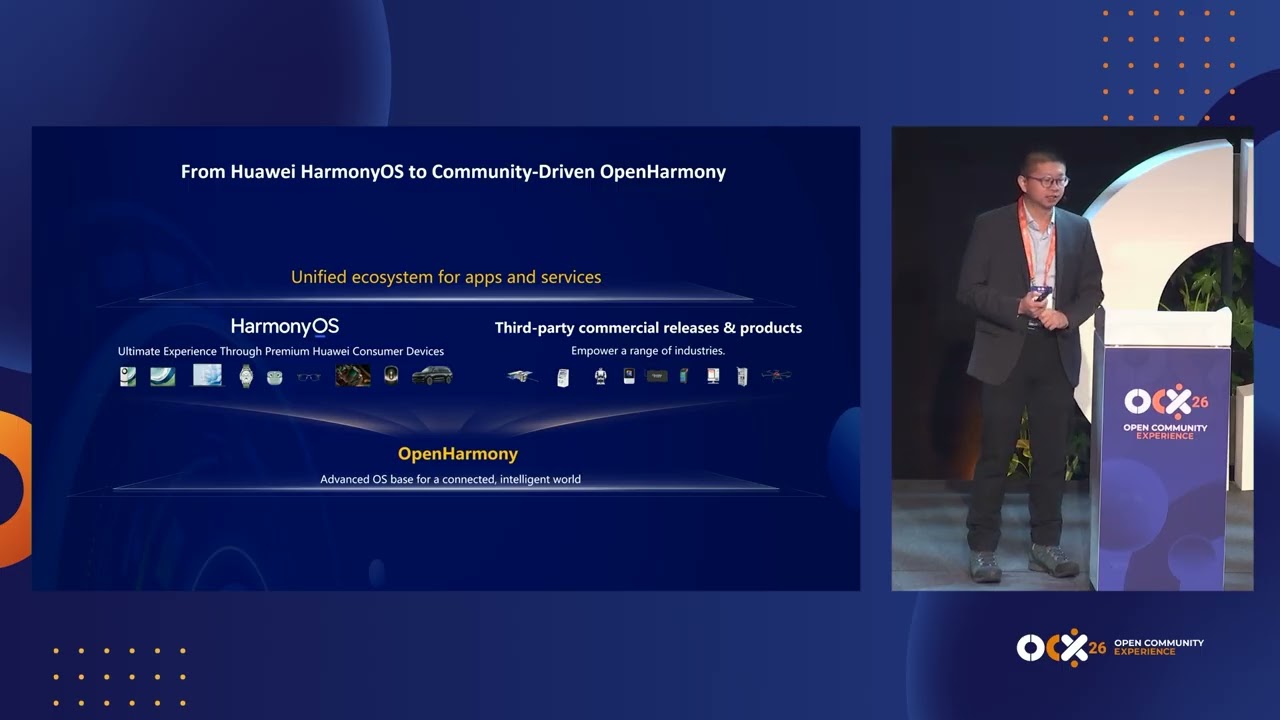
reception, uh, tonight, uh, we have a stand-up comedy show, and another, uh, networking reception tomorrow night. And with that, have fun and enjoy, uh, OCX. >> And now it's my great pleasure to introduce the next keynote speaker, Yutao Liu, uh, from, uh, Huawei, who is going to be talking to us about Open Harmony, unleashing surging connected and intelligent innovation. I'm sure everybody has a smartphone in your
pocket today. Um, Open Harmony is is is a new operating system that is really changing how these technologies can interact with the other devices around us. I think this is a really exciting technology. Of course, we also have the AOSP project, which is a European distribution of Open Harmony, and I think that's a really great model for us to see how to bring technologies from around the
world for use in Europe. So, with that, Yu Tao Li, thank you very much.